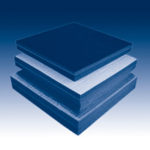
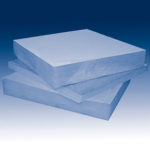
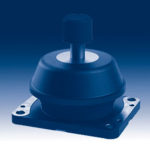
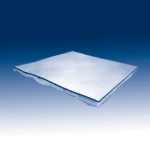
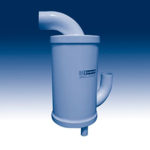
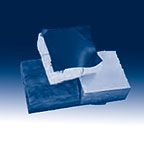
QuietClad panels can be used whenever the purpose is to damp structure-borne noise. It's noise-damping capacity is practically independent of the thickness of the system, and QuietClad panels can therefore be chosen solely with regard to the strength of the structure.
QuietClad panels are used in machinery such as vibrators and chutes, the noise level of which can be reduced by between 10 and 20 dB(A).
In certain cases the use of double-wall constructions may be justified. Two QuietClad panels can then be connected with strips or bolts without significantly detracting from their sound-insulating properties. The space between the panels should be filled with mineral wool, foam plastic or some other type of sound absorbent material.
Effective sealing to prevent sound leakage is extremely important when insulating against noise, since even very small gaps may significantly affect the result.
Soundown’s Noiseless Steel is a sandwich panel for the damping of structure-borne sound, consisting of two sheets of metal with a plastic inner layer (Metal-Plastic-Metal). QuietClad panels provide very |
good damping of structure-borne noise as well as good insulation of air-borne sound.
Where both sheets of metal are of the same thickness, the system is described as symmetrical. If they are of different thicknesses the system is asymmetrical.
Symmetrical QuietClad systems provide slightly better vibration damping than asymmetrical systems with the same total weight, but the difference is small as long the asymmetry ratio does not exceed 1:4.
The standard QuietClad panel is a sandwich of galvannealed sheet steel enclosing an inner layer of plastic with a high damping ability.
QuietClad panels can also be supplied in special materials, such as stainless steel, aluminum or cold rolled. Different materials can be combined - for example stainless steel on one side and aluminum on the other.
Contact corrosion is effectively prevented, since the plastic inner layer isolates the plates from each other. Most industrial painting methods can be used and this provides further protection against corrosion. |
- Quiet equates to quality.
- Reduced noise level of 10-20 dB.
- Built in environmental (OSHA) compliance.
- Noiseless steel can be welded, formed and stamped
- A variety of materials can be used for the sandwiched steel panels (e.g., Deep-drawn steel, Stainless Steel, Aluminum, Plastic-laminated or enameled sheet metals, etc.)
- Competitively priced with other damping materials.
- Overall size/thickness will remain the same or be less than current damping application.
|
|
Structure of metal, wood, concrete and so on generally have very low internal losses. In other words, their ability to convert vibrational energy into thermal energy is poor. This means that resonant vibrations that may occur when a structure is subjected to vibration and structure-borne noise, are of high amplitude, and this usually also results in the radiation of considerable air-borne noise.
The internal losses in a material or structure are commonly represented by the loss factor 11, which is a measure of how much of the vibrational energy is converted into heat.
The loss factor is a property of materials in just the same way as the modulus of elasticity and the density. The highest realistically possible figure for the loss factor is around 1.0. For sheet metal structures, it is usually between 0.001 and 0.01; in other words, the internal losses are negligible. However, the loss factor can be improved by using sound and vibration - damping materials.
The most common methods for this are extensional layers and sandwich construction. QuietClad panels are |
an example of sandwich construction and can, in optimum conditions, achieve loss factor figures above 0.5.
Results as good as this are seldom obtained with extensional layers. This is because these undergo elongation/compression when subjected to bending waves, whereas the inner layer of QuietClad panels is subjected to shear. Deformation in shear converts larger amounts of energy than elongation, giving higher energy losses, and this results in a higher loss factor.
Unlike for extensional damping, thick constructions can be given high loss factors using QuietClad panels

Figure 1. When subjected to bending wave vibrations, extensional layers undergo elongation/ compression: the inner layer of QuietClad panels is subject to shear. |
The properties of all damping materials are dependent to a greater or lesser extent on temperature and frequency. Figure 3 shows the temperature-dependence of the loss factor at 200 and 1000 Hz for Soundown's QuietClad .020/.004/.020. Figure 2 shows the loss factor as a function of frequency at +20' C (6S"F) for the same panel.

Figure 2. Graph of loss factor against frequency for Soundown's QuietClad .020/.004/.020 + 20'C (6S'F). |

Figure 3. Loss Factors of QuietClad .020/.004/.020 at 200 and 1000 Hz as. |